Scaling a fish farm can seem like the natural next step after early success. However, many fish farms fail after scaling because larger operations are far more difficult to manage than small ones. Expanding a farm is not just about adding more ponds, tanks, or fish. It also means dealing with more complex water quality issues, higher disease pressure, feeding inefficiencies, and a less stable production environment.
In many cases, fish farms fail after scaling because the systems that worked well at a small level do not perform the same way at a commercial level. Without careful planning, growth can quickly lead to poor fish health, lower survival rates, and financial losses.
Below are four major reasons fish farms fail after scaling and what producers need to watch closely.
1. Water Quality Problems Increase as Fish Farms Scale
One of the biggest reasons fish farms fail after scaling is poor water quality management. In small systems, operators can usually control oxygen levels, water turnover, temperature, and waste buildup more easily. As the farm expands, maintaining the same balance becomes much harder.
Large ponds and tanks often develop uneven circulation, poor aeration, and waste accumulation in certain areas. These conditions can create dead zones where dissolved oxygen drops and ammonia levels rise. Even slight variations in pH or temperature can stress fish and reduce growth.
According to the FAO’s guidance on dissolved oxygen, oxygen is one of the most important factors in fish survival and performance. Likewise, the FAO’s material on water quality and fish health shows how water chemistry directly affects fish health and production.
To avoid failure after scaling, fish farms need stronger monitoring systems, better aeration design, and faster response protocols.
2. Disease Outbreaks Spread Faster in Large-Scale Fish Farms
Another major reason fish farms fail after scaling is the increased risk of disease. As stocking density rises, fish are packed more closely together, which makes it easier for pathogens to spread. At the same time, stress from poor water quality weakens immune response and leaves fish more vulnerable.
A disease event in a small fish farm may affect one section of the operation. In a large-scale farm, the same outbreak can move rapidly through the entire stock and cause major losses. This is one of the clearest ways fish farms fail after scaling.
FAO emphasizes the importance of aquatic health management and biosecurity in reducing disease risks in aquaculture. Stronger biosecurity systems are essential when farms grow larger because equipment, water sources, workers, and routine movement can all introduce pathogens.
Fish farms that scale successfully treat disease prevention as a core management system, not an afterthought.
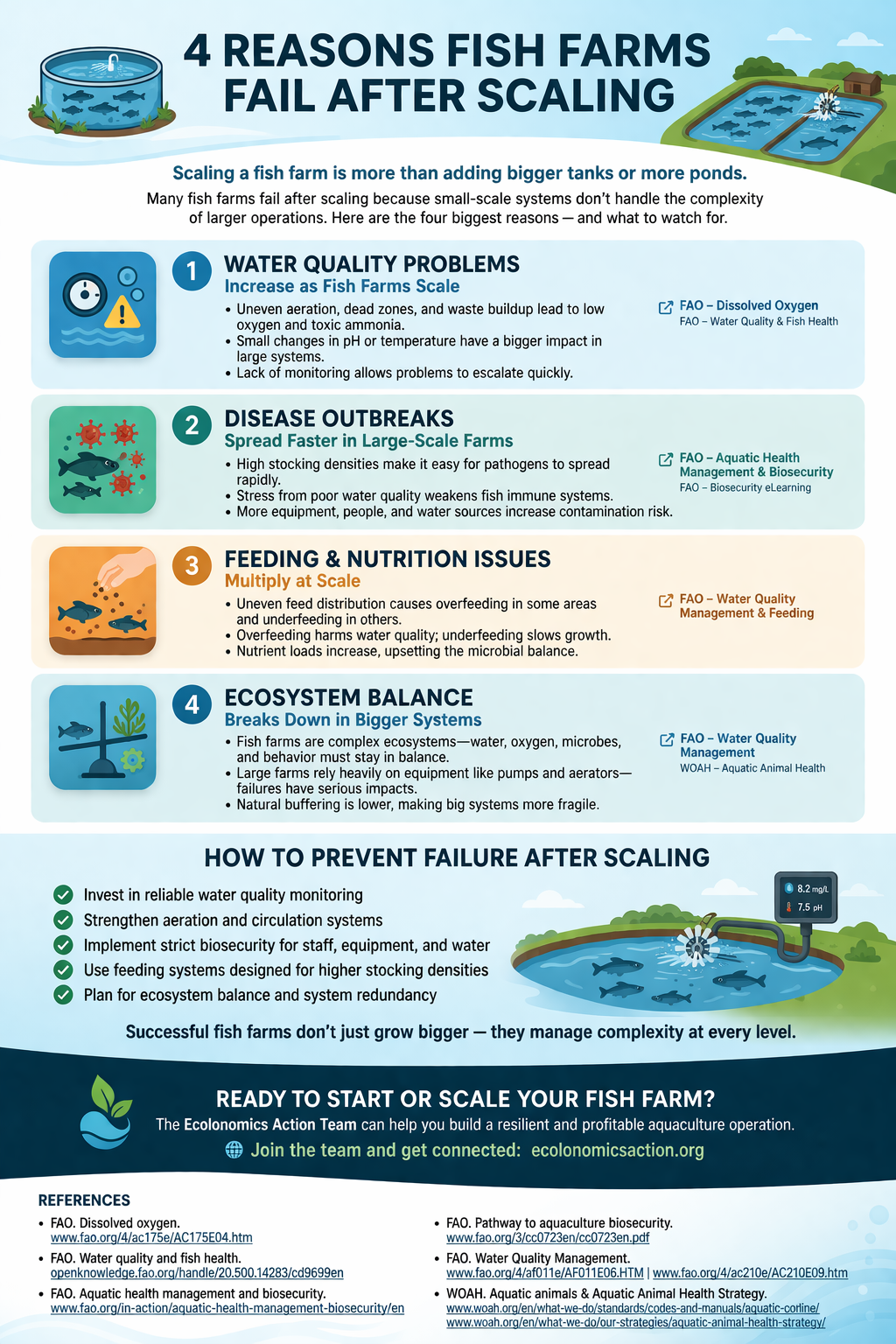
3. Feeding and Nutrition in Fish Farms Become Less Efficient at Scale
Feeding problems are another common reason fish farms fail after scaling. A feeding strategy that works well with a small population may become inefficient or inconsistent in a much larger system.
In larger ponds or tanks, feed may not be distributed evenly. Some fish get too much, while others get too little. Overfeeding raises nutrient loads and contributes to poor water quality. Underfeeding reduces growth rates and can increase competition and aggression.
The FAO’s aquaculture resources on water quality management explain that feeding intensity directly affects production performance and environmental conditions. Poor feeding practices can quickly damage both water quality and profitability.
To reduce the risk of failure, larger fish farms need better feed delivery systems, more consistent monitoring, and nutrition plans built specifically for higher stocking levels.
4. Ecosystem Balance Breaks Down in Larger Fish Farming Systems
Fish farms are not just production units. They are living ecosystems. Water, oxygen, microbes, fish behavior, plants, and mechanical systems all interact. As a farm grows, those interactions become much more difficult to balance.
This ecosystem complexity is a hidden reason fish farms fail after scaling. Larger operations often rely more heavily on pumps, aerators, filters, and circulation systems. If one part fails, the impact can be immediate and severe. Smaller farms sometimes have enough natural buffering to absorb a problem. Larger farms usually do not.
FAO’s guidance on water quality management notes that prolonged low oxygen and unstable conditions can reduce growth, lower disease resistance, and trigger mortality.
Scaling a fish farm means scaling biological complexity at the same time. Producers who ignore this often discover too late that bigger systems are also far more fragile.
How to Prevent Fish Farms’ Failure After Scaling
Fish farms fail after scaling when growth happens without stronger systems in place. Expansion should include more than infrastructure. It should also include better water monitoring, tighter biosecurity, improved feeding management, and a deeper understanding of system balance.
Fish farms that succeed at scale usually have:
- reliable water quality monitoring
- strong aeration and circulation design
- biosecurity protocols for staff, equipment, and water
- feeding systems suited for larger populations
- backup systems for pumps, aerators, and filtration
- management practices built around fish health and environmental stability
Conclusion
Fish farms fail after scaling for several predictable reasons. Water quality becomes harder to manage, disease spreads faster, feeding becomes less efficient, and ecosystem complexity increases. These problems do not always show up on a small farm, but they often become severe once the operation expands.
The fish farms that thrive at scale are the ones that prepare for these challenges early. They understand that growth is not just about size. It is about maintaining control, balance, and biological stability as complexity increases.
Start your own fish farm
Are you thinking about starting or expanding a commercial fish farm? The Ecolonomics Action Team provides practical guidance, valuable information, and access to experienced fish farmers who understand what it takes to build a resilient and profitable aquaculture operation. Join the team and get connected.
References
- Land-Based vs. Cage Fish Farming: A Practical Guide to Choosing the Right Aquaculture System
- FAO. Water Quality for Aquaculture and the Impact of Aquaculture to Environments.
- FAO. Water quality and fish health.
- FAO. Aquatic health management and biosecurity.
- FAO. Pathway to aquaculture biosecurity: managing disease risks in the value chain.
- FAO. Dissolved oxygen.
- FAO. Water Quality Management.
- FAO. Aquaculture development. Health management for the responsible movement of live aquatic animals.
- WOAH. Aquatic animals.
- WOAH. Aquatic Animal Health Strategy.