Why Fish Farms Collapse After Sudden Growth Spikes
Rapid growth can look like success. More fish, faster turnover, and higher revenue all seem like signs that a farm is moving in the right direction. However, in aquaculture, sudden expansion can also push a system beyond its limits. What works at one scale does not always work at the next. As a result, when growth outpaces system capacity, collapse becomes much more likely.
At the center of this problem is uncontrolled scaling.
Biological Load Exceeds System Capacity
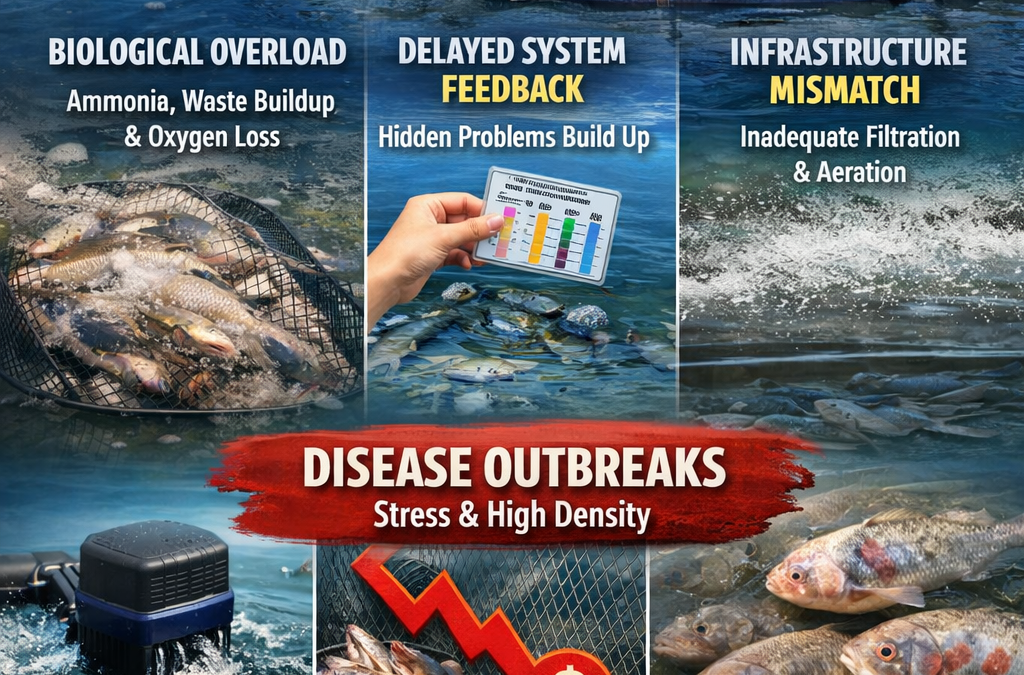
Every fish farm operates within a biological carrying capacity. In simple terms, water can only hold so much oxygen, process so much waste, and support a stable microbial balance for a given level of production. When stocking density rises too quickly, waste production can increase faster than the system can safely handle.
Consequently, ammonia, nitrites, and organic matter begin to build up while oxygen demand rises. Both FAO’s guidance on water quality management and its technical material on water quality and fish health emphasize how critical dissolved oxygen and ammonia control are in intensive aquaculture.
At first, the system may appear to absorb the added pressure. Eventually, though, it can reach a tipping point. Then even a relatively small change in feeding, temperature, or oxygen availability can trigger a much larger problem.
Delayed System Feedback
Just as importantly, aquaculture systems often do not fail immediately. Water quality may still look acceptable on the surface while deeper imbalances are quietly building underneath. Microbial communities can shift, waste can accumulate, and oxygen reserves can tighten before obvious warning signs appear.
This delayed feedback is one reason fish farms can seem stable right up until they are not. Because of that delay, farmers may develop a false sense of security. By the time fish start showing visible stress, the system may already be unstable. Therefore, corrective action becomes reactive instead of preventive.
Feed Input Escalation
At the same time, sudden growth nearly always means more feed. Increased feeding raises nutrient loading, which directly affects water quality. Uneaten feed and fish waste stimulate microbial activity, and that process consumes oxygen while contributing to harmful byproducts.
In addition, feed efficiency often declines when fish are under stress. So, more feed goes in, but less of it turns into healthy growth. That creates both biological strain and financial pressure. Research and industry guidance on feed management and production efficiency consistently point to the importance of adjusting feed to real-time conditions rather than simply increasing volume.
In other words, the system becomes heavier, more fragile, and less efficient all at once.
Infrastructure Mismatch
Moreover, rapid expansion often happens before infrastructure is truly ready. Aeration systems, filtration units, water exchange capacity, and monitoring tools may still be sized for a smaller operation. As production rises, these systems can become bottlenecks.
Oxygen distribution may become uneven, filtration may become inadequate, and water circulation may weaken. NOAA’s work on aquaculture planning and best practices highlights the importance of matching farm design, monitoring, and management capacity to production scale. You can explore more through NOAA’s Coastal Aquaculture Planning Portal and its review of biosecurity and disease management best practices.
Instead of scaling smoothly, the farm develops weak points. Then, under pressure, those weak points are usually where failure begins.
Disease and Stress Amplification
Furthermore, high-density conditions combined with unstable water quality create ideal conditions for disease. Fish under chronic stress tend to have weaker immune responses, which makes them more vulnerable to pathogens. At the same time, crowded conditions allow disease to spread faster through the population.
Environmental stressors such as low dissolved oxygen, high ammonia, and poor water conditions are widely recognized as major contributors to fish health problems. You can read more in this overview of fish health management.
As a result, outbreaks that would have been manageable at a smaller scale can quickly become severe. Mortality rises, treatment costs increase, and apparent growth turns into financial loss.
Economic Overextension
Finally, sudden expansion can strain the business side just as much as the biological side. More fish usually means more feed purchases, higher stocking costs, more labor, and greater operating expenses. However, when biological performance slips, revenue often fails to keep up with those rising costs.
This leaves the farm carrying bigger expenses with lower efficiency. Then a single mortality event, oxygen crash, or production delay can push the entire operation into loss. For that reason, fast growth is not always healthy growth.
Conclusion
Fish farms collapse after sudden growth spikes because biological systems do not scale instantly. Water quality, infrastructure, and ecosystem balance all need time, planning, and careful design to adjust. When growth happens without matching system expansion, hidden instability builds below the surface. The farm may look successful for a while, but eventually several limits are reached at the same time.
Therefore, sustainable scaling in aquaculture must be controlled, incremental, and supported by strong infrastructure and close monitoring. The goal is not just rapid growth. Instead, the goal is stable growth.
In fish farming, expanding too fast is not true acceleration. It is a compression of risk.
Build Your Own Fish Farm
Want to build a fish farm that grows without breaking under pressure? Join the Ecolonomics Action Team and learn from experienced farmers who understand how to scale aquaculture systems in a practical, resilient, and profitable way.
Resources
- FAO, Water Quality Management
- FAO, Water Quality and Fish Health
- NOAA, Review of Best Practices for Biosecurity and Disease Management in Aquaculture
- NOAA, Coastal Aquaculture Planning Portal
- The Fish Site, Feed Management for Improving Production and Economic Returns
- The Fish Site, An Introduction to Fish Health Management