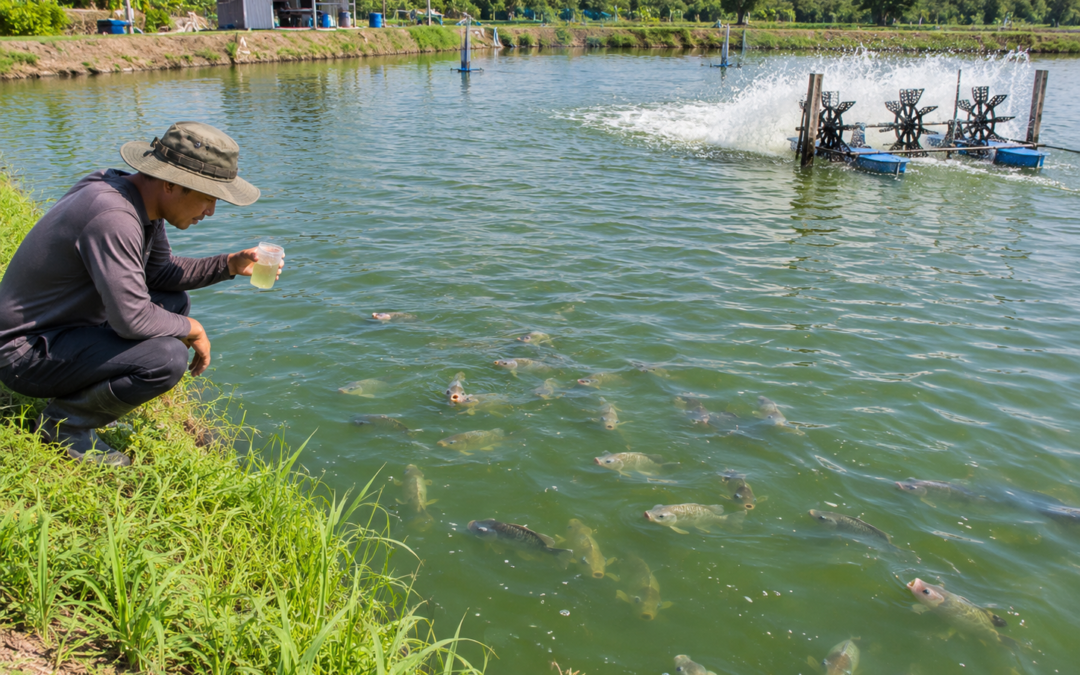
Algae are a natural part of fish-pond ecosystems, and their presence is not automatically a problem. Microscopic algae called phytoplankton form an important part of the pond food web and produce oxygen during daylight through photosynthesis. The phytoplankton blooms are essential in commercial fish ponds because they supply dissolved oxygen and help absorb nitrogenous fish wastes. Problems develop when nutrients, fish biomass, weather, and organic matter push the pond out of balance and algae become excessively dense.
Managing algae is therefore about maintaining balance rather than trying to eliminate all algae. A healthy pond needs enough phytoplankton to support productivity without allowing blooms to become so dense that they create unstable oxygen conditions. Regular observation, careful feeding, nutrient control, and timely water-quality management are more effective than waiting until a bloom has already become a fish-health emergency.
Algae Are Part of a Healthy Pond
Phytoplankton use sunlight and nutrients to grow, and they provide food for zooplankton and other small organisms that are eaten by fish. During daylight, they also release oxygen into the water. University of Georgia Extension describes planktonic algae as an important base of the pond food chain that provides food and oxygen for fish, so completely clear water is not always the goal in a productive fish pond.
The problem begins when the phytoplankton population becomes too dense. Oklahoma State University recommends using a Secchi disk to measure water visibility and reports that readings of less than 12 inches indicate a much higher risk of an algal die-off and fish kill. A Secchi disk is a simple circular disk lowered into the pond until it disappears from view, giving farmers a practical way to monitor changes in water clarity rather than relying only on water color.
Color is still useful as an early warning. A sudden change from green water to brown, gray, or clearer water may indicate that part of a bloom is dying, while increasingly dense green water may signal rising phytoplankton abundance. Visual changes should prompt closer monitoring because color alone cannot tell a farmer how much dissolved oxygen is present or whether a bloom is about to collapse.
Control Nutrients Before They Feed a Bloom
Excess nutrients are one of the main drivers of unwanted algal growth. Nitrogen and phosphorus may enter a pond through fertilizers, livestock manure, runoff, fish waste, and uneaten feed. University of Georgia Extension notes that nutrients such as nitrogen and phosphorus can dramatically increase plant and algal growth and identifies fertilizer, livestock manure, grass clippings, yard waste, and fish feed as common nutrient sources.
Feed is especially important in commercial aquaculture ponds. The Southern Regional Aquaculture Center reports that food added to ponds is the major nutrient source in commercial fish production systems, and summer feeding rates in catfish production may exceed 150 pounds per acre per day. Nutrients from uneaten feed and fish waste eventually enter the water or pond bottom, where they can support additional phytoplankton growth and increase the amount of organic material that must be decomposed.
Good feeding management therefore helps both production economics and water quality. Farmers should match feed amounts to fish biomass, appetite, water temperature, and observed feeding activity instead of routinely adding more feed than fish will consume. Vegetated pond banks and buffer areas can also help reduce sediment, fertilizer, and manure entering through runoff, addressing the nutrient source rather than repeatedly treating the algae that result from it.
Protect Dissolved Oxygen
Dense algal blooms become dangerous when they contribute to unstable dissolved-oxygen conditions. During daylight, algae produce oxygen, but algae, fish, bacteria, and other organisms continue consuming oxygen through respiration throughout the day and night. When sunlight disappears at night, photosynthesis stops, so oxygen concentrations often reach their lowest point shortly before sunrise.
Cloudy conditions can make this problem worse because less sunlight means less photosynthesis. The University of Georgia’s Oxygen Depletion in Ponds, Circular 1048 states that most pond oxygen depletions occur during warm weather and commonly follow cloudy, overcast conditions. The same guidance notes that fish losses can have serious economic consequences, giving the example that largemouth bass, bream, and grass carp in a managed pond may be worth more than $3,000 per acre.
A sudden algal die-off creates another risk because bacteria consume oxygen while decomposing dead algae. Farmers should pay particular attention when pond color changes rapidly, fish stop feeding normally, or fish begin gathering near the surface. Aeration equipment can provide an important safeguard, but it works best when farmers have a plan in place before oxygen levels become critically low rather than waiting until fish are visibly stressed.
Treat Excess Algae Carefully
When algae become excessive, the correct response depends on the type of algae and the cause of the problem. Physical removal may work for mats of filamentous algae in small ponds, while nutrient reduction, aeration, water management, or an approved aquatic algicide may be appropriate in other situations. University of Georgia Extension recommends identifying the type of algae before choosing a control method because planktonic, filamentous, and macroalgae differ in how they grow and how they should be managed.
Chemical control requires particular care. Mississippi State University Extension recommends that during heavy planktonic blooms farmers treat only one-third of the pond at a time and wait two to three days between treatments. Treating an entire heavy bloom at once can produce a large amount of decomposing material and increase the risk of dissolved-oxygen depletion.
Water chemistry also affects treatment safety. The same Mississippi State guidance warns that copper should not be used in catfish or koi ponds when alkalinity is below 50 parts per million because copper becomes more toxic to fish at low alkalinity. Farmers should measure pond conditions, identify the algae correctly, and follow the product label before applying any aquatic herbicide or algicide.
Algae management is ultimately part of overall pond management. A productive pond needs enough phytoplankton to support its food web and contribute oxygen during daylight, but excessive nutrients and dense blooms can make that system unstable. Careful feeding, nutrient control, routine observation, water-quality monitoring, aeration planning, and cautious treatment help farmers maintain the balance needed for healthy fish and dependable production.
Join the EAT Community at https://www.eatcommunity.com/ to learn from experienced farmers and explore practical strategies for regenerative farming.