Fish farming is not just a local decision—it’s part of a much larger global system. If you want broader context on how different aquaculture models are being used, regulated, and scaled across regions, explore our Worldwide Aquaculture overview to see how land-based and cage systems fit into global production trends.
If you’re researching fish farming methods, you’ll quickly run into two dominant models:
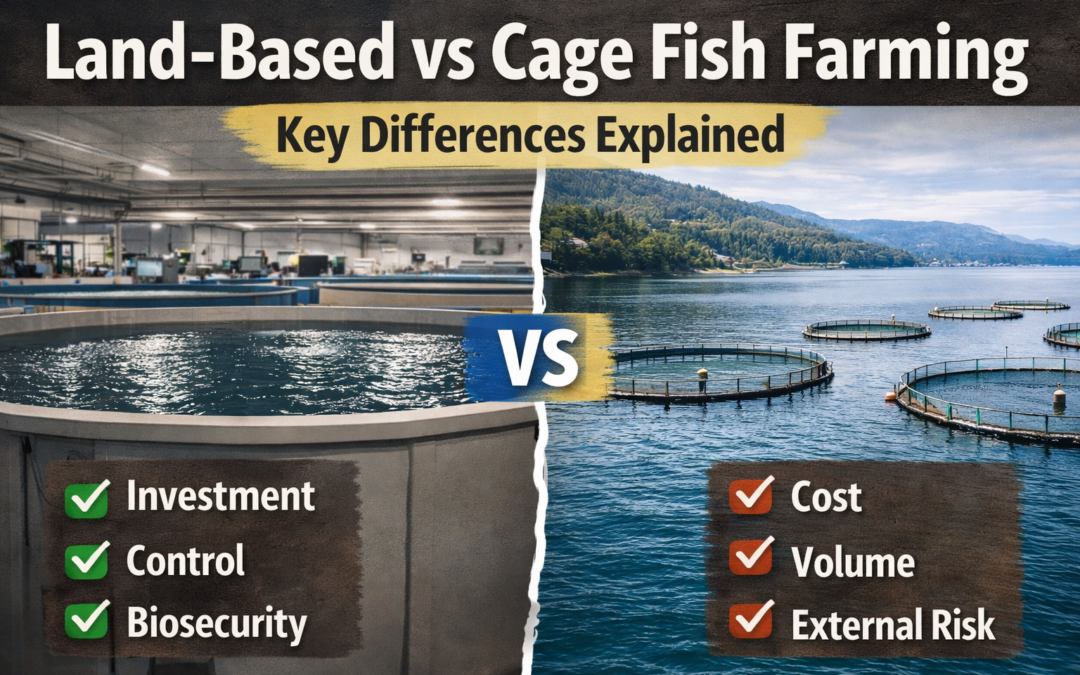
land-based fish farming and cage fish farming. This guide breaks down the real trade-offs
so you can choose the best aquaculture system for your goals.
neither system is “best” by default. One is simply better for your location, budget, market, and risk tolerance.
The difference comes down to control, cost, environmental exposure, and scalability.
What Is Land-Based Fish Farming?
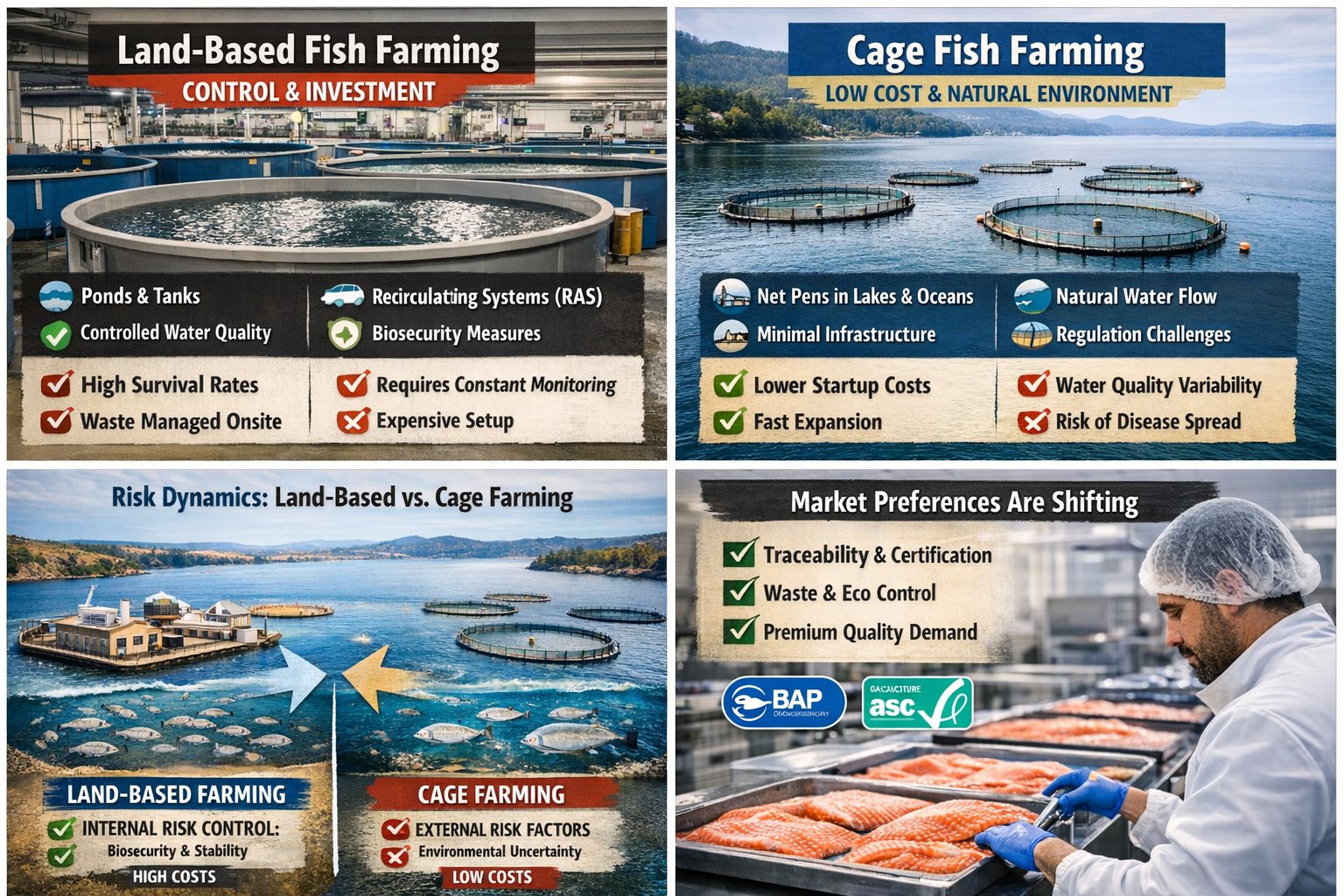
Land-based fish farming happens entirely on land using ponds, tanks, raceways, or recirculating aquaculture systems (RAS).
This is the model people usually mean when they say “controlled aquaculture.”
Why farmers choose land-based systems
The biggest advantage is simple: you’re in control.
- Water quality and oxygen levels
- Stocking density
- Feeding schedules
- Disease exposure
- Harvest timing
That control leads to more predictable production and typically higher survival rates.
Land-based farms can also align more easily with wastewater rules because waste can be captured and treated.
For regulatory context, see the U.S. EPA aquaculture guidance.
The downside of land-based fish farming
Control comes at a cost. Land-based systems usually require higher capital investment and ongoing operating costs, including:
- Infrastructure (tanks/ponds, plumbing, buildings)
- Pumps, aeration, and filtration
- Energy and backup power
- Skilled monitoring and maintenance
Important: RAS facilities can be unforgiving. A power outage or mechanical failure can escalate quickly without redundancy.
Want deeper background on RAS? Start with this overview of recirculating aquaculture systems (FAO).
What Is Cage Fish Farming?
Cage fish farming uses net pens placed directly into lakes, reservoirs, rivers, or coastal waters.
Instead of building full water-treatment infrastructure, the surrounding environment provides water exchange and oxygen.
Why cage farming is attractive
The main advantage: lower startup costs.
- Faster to launch
- Easier to expand
- Lower cost per unit of fish (in many settings)
When conditions are favorable, growth rates can be excellent due to steady water flow and stable temperatures.
The risks of cage fish farming
Here’s the catch: you don’t control the environment.
Water quality, pollution events, and disease pressure are external factors. If something changes,
intervention options are limited—and problems can spread quickly between cages and farms.
Cage systems often face higher environmental scrutiny because waste and excess feed enter the ecosystem directly.
For broader sustainability perspective, explore the FAO aquaculture sustainability resources.
Productivity vs. Risk: The Real Trade-Off
Most decisions come down to this:
- Land-based systems prioritize survival, consistency, and biosecurity.
- Cage systems prioritize volume and lower production costs.
Simple rule of thumb:
Cage farming tends to externalize risk to the environment.
Land-based farming tends to internalize risk inside your operation.
Environmental Impact and Market Demand
Buyers are paying closer attention to traceability, waste control, and biosecurity—especially in premium and export markets.
Land-based operations often have an advantage because inputs and outputs can be documented more precisely.
If you’re thinking about certification-driven markets, review:
Best Aquaculture Practices (BAP)
and the Aquaculture Stewardship Council (ASC).
Land-Based vs. Cage Fish Farming: Which Is Better?
Here’s the honest answer: they are not interchangeable.
- Land-based fish farming offers control, predictability, and regulatory resilience—at higher cost.
- Cage fish farming offers affordability and scalability—with higher biological and environmental risk.
The best aquaculture system is the one that matches your:
- Local regulations
- Water availability and quality
- Target markets and buyer expectations
- Environmental carrying capacity
- Budget and risk tolerance
The wrong system choice rarely fails slowly. It usually fails decisively.
Ready to Explore Aquaculture the Smart Way?
If you’re serious about aquaculture—and you want to do it in a way that’s economically viable and environmentally responsible—
you don’t have to figure it out alone.
Connect with the Ecolonomics Action Team (EAT) to access practical resources, expert guidance, and a community focused on
making a little money while making the planet better.