A farm can produce much more efficiently when its different activities work together instead of operating as completely separate systems.
That is the basic idea behind integrated fish farming systems.
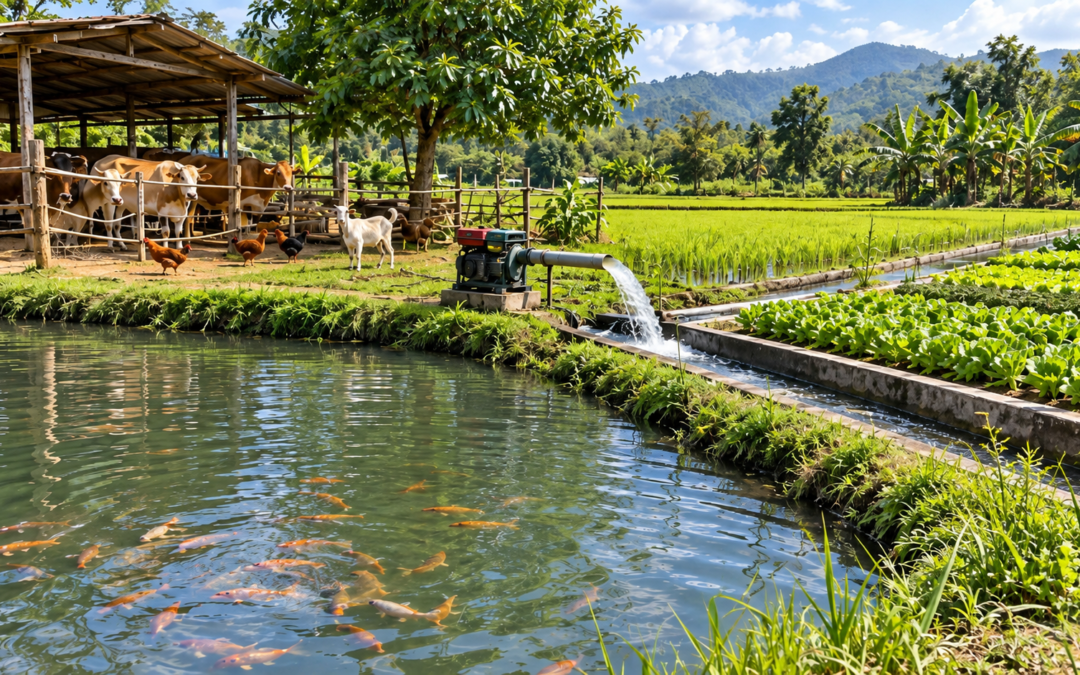
Integrated fish farming combines aquaculture with other agricultural activities such as crop production and livestock raising. Water, nutrients, organic matter, crop residues, and other farm resources can move between the different parts of the farm instead of being discarded after a single use.
When designed and managed carefully, this approach can improve resource efficiency, reduce waste, diversify farm production, and create additional sources of income.
Rather than viewing a fish pond as an isolated enterprise, integrated farming treats it as part of a larger agricultural system.
Fish Ponds Can Support Crop Production
Fish ponds do more than produce fish.
Over time, pond water may accumulate nutrients from fish waste, uneaten feed, natural biological processes, and organic matter.
When water quality and nutrient levels are appropriate, some of this water can be reused for irrigating crops.
This creates a connection between aquaculture and crop production.
Instead of simply releasing pond water, farmers may be able to use it to supply both water and some nutrients to fields, gardens, orchards, or vegetable crops.
In some integrated systems, pond sediment can also be removed periodically and used as a soil amendment.
The exact benefits depend on water quality, nutrient concentration, crop requirements, soil conditions, and local regulations.
Careful management is therefore essential.
Livestock Can Provide Nutrients for Ponds
Livestock can also become part of an integrated fish farming system.
Manure contains nutrients that may stimulate the growth of algae, plankton, and other natural food organisms in fertilized fish ponds.
Historically, livestock-fish farming has been practiced in a number of regions, particularly in Asia.
However, manure should never be treated as an unlimited resource.
Excessive organic loading can create serious water-quality problems.
Too much manure or other organic material may increase oxygen demand, encourage excessive algal growth, alter pH, and create stressful conditions for fish.
For this reason, livestock manure should be applied only where appropriate and at carefully managed rates.
Farmers must consider pond size, fish species, stocking density, climate, water exchange, nutrient levels, and local food-safety or environmental requirements.
Crops Can Provide Fish Feed Resources
The relationship can also work in the other direction.
Some crop materials and agricultural by-products may be useful as fish-feed ingredients when they are safe, properly processed, and nutritionally appropriate for the species being raised.
Potential materials may include:
- Bran
- Grain by-products
- Vegetable trimmings
- Crop residues
- Oilseed by-products
- Other locally available plant materials
However, agricultural by-products should not simply be thrown into fish ponds.
Fish require balanced nutrition, and the suitability of any feed ingredient depends on the species, life stage, digestibility, nutrient composition, processing method, and feeding rate.
Improper feeding can reduce growth and increase waste.
Integrated systems work best when farm by-products are treated as carefully managed resources rather than as convenient disposal materials.
Pond Water Can Be Reused
Water is often one of the most valuable resources on a farm.
Integrated farming can create opportunities to use the same water for more than one productive purpose.
For example, pond water may be used for:
- Irrigating vegetables
- Watering orchards
- Supporting forage crops
- Maintaining other farm vegetation
- Supplying water to integrated crop areas
This can be especially useful in areas where water is limited.
Water reuse can reduce the amount of new water required for certain farm activities while keeping nutrients within the farm system.
The key is to match water quality with its next intended use.
Salinity, nutrient concentration, pathogens, suspended solids, medications, and other factors may determine whether pond water is suitable for a particular crop or irrigation method.
Fish Waste Can Become a Farm Resource
Fish naturally contribute organic matter and nutrients to pond water.
Waste comes from fish metabolism, uneaten feed, microorganisms, algae, and other biological processes.
In a poorly managed system, excessive waste can become a water-quality problem.
In a well-designed integrated system, however, some of those nutrients may be captured and reused.
Pond water can support crops.
Pond sediment may sometimes be incorporated into agricultural soils.
Aquatic plants may absorb nutrients and, depending on the system, later become useful biomass.
This illustrates one of the main principles of integrated agriculture:
One part of the farm can use resources that might otherwise become waste in another part.
Integration Can Reduce Farm Waste
Traditional farming activities often create by-products.
Crop production produces plant residues.
Livestock produces manure.
Fish farming produces nutrient-rich water and pond sediments.
Integrated systems look for safe and productive ways to connect these materials.
Crop residues may become animal feed, compost, or selected fish-feed ingredients.
Livestock manure may contribute nutrients to crops or carefully managed ponds.
Pond water may irrigate crops.
Pond sediments may contribute organic matter and nutrients to soil.
The objective is not to reuse every waste stream automatically.
Instead, the goal is to identify useful connections while avoiding excessive nutrient loading, contamination, or environmental harm.
Properly designed integration can improve the efficiency with which the farm uses land, water, nutrients, and organic matter.
Multiple Activities Can Diversify Farm Income
One important economic advantage of integrated farming is diversification.
A farmer who depends entirely on one crop or one livestock enterprise may face significant risk when prices fall, yields decline, disease occurs, or weather damages production.
Integrated farms can produce several products.
Depending on the system, these may include:
- Fish
- Vegetables
- Fruit
- Grain
- Livestock
- Eggs
- Milk
- Forage crops
- Compost or other farm products
Several enterprises can create more than one source of farm income.
This does not eliminate risk, but it can reduce dependence on a single product.
WorldFish research on integrated agriculture-aquaculture has highlighted diversification of food and income sources as one potential benefit of these farming systems.
Integrated Farming Can Improve Resource Efficiency
The strength of an integrated system comes from the connections between its components.
A fish pond may provide irrigation water.
Crops can provide residues or feed ingredients.
Livestock can provide nutrients.
Plants can use nutrients that might otherwise leave the farm.
These linkages can reduce the need for some external inputs.
In many systems, the pond becomes an important center for storing and recycling water and nutrients.
FAO has documented examples in which nutrient-rich pond water irrigates crops, pond mud fertilizes fields, and crop residues or other farm products contribute to fish production.
Farm Management Becomes More Complex
Integrated farming offers potential benefits, but it also requires more management.
Instead of focusing on one enterprise, the farmer must understand how several enterprises affect one another.
Fish production may require monitoring:
- Stocking density
- Fish growth
- Feed use
- Dissolved oxygen
- Water temperature
- pH
- Nutrient levels
Crop production has its own requirements.
Livestock manure must be collected, stored, treated, and applied appropriately.
Irrigation schedules need to match crop demand and pond-water availability.
A mistake in one part of the system can affect another.
For example, excessive feeding can increase nutrient concentrations in pond water. Excessive organic loading can reduce dissolved oxygen. Poor manure management can create contamination or food-safety risks.
Integration therefore requires planning rather than simply placing fish, crops, and livestock together.
Water Quality Must Be Carefully Controlled
Water quality is one of the most important management considerations in integrated fish farming.
Fish depend directly on the aquatic environment for oxygen, feeding, growth, and survival.
When too much feed, manure, fertilizer, or organic matter enters a pond, decomposition can consume oxygen.
Excess nutrients can also stimulate heavy algae growth.
During the day, algae can produce oxygen through photosynthesis. At night, however, algae and other organisms consume oxygen through respiration.
Under unfavorable conditions, dissolved oxygen can drop to stressful or dangerous levels.
Important pond conditions to monitor can include:
- Dissolved oxygen
- Temperature
- pH
- Ammonia
- Water clarity
- Algal growth
- Nutrient loading
- Fish behavior
Sudden changes in fish feeding or behavior may also indicate deteriorating water conditions.
Regular monitoring allows farmers to adjust feeding, fertilization, aeration, manure inputs, or water exchange before conditions become severe.
Not Every Farm Should Use the Same Integrated System
Integrated fish farming is not a single standardized model.
Successful systems vary depending on location.
Important factors include:
- Climate
- Water availability
- Fish species
- Crop choices
- Livestock species
- Soil type
- Farm size
- Market access
- Labor availability
- Food-safety requirements
- Environmental regulations
A rice-fish system in Asia may operate very differently from a fish-and-vegetable system in Africa or a livestock-fish system elsewhere.
Farmers should design integration around the resources and limitations of their particular farm rather than simply copying another operation.
Planning Makes Integration Work
Successful integration depends on understanding how materials move through the farm.
Farmers need to know where water comes from, where nutrients accumulate, how much feed is being used, how much organic material is entering the pond, and where by-products can be reused safely.
A basic farm nutrient-flow plan can help identify opportunities.
Ask questions such as:
- Can pond water irrigate nearby crops?
- Can crop residues become feed or compost?
- Can pond sediment improve soil?
- Are livestock nutrients being used efficiently?
- Where could excess nutrients accumulate?
- Is enough oxygen available for the fish?
- Could one enterprise create a risk for another?
Answering these questions helps turn a collection of farm activities into an integrated system.
Conclusion
Integrated fish farming systems connect aquaculture with crops, livestock, and other agricultural activities so that farm resources can be used more efficiently.
Fish ponds can supply irrigation water and nutrients to crops.
Livestock manure can, in appropriate systems, contribute nutrients to pond food webs.
Crop by-products may become useful feed resources.
Pond water and sediments can sometimes be reused instead of discarded.
These connections can help reduce waste and diversify farm output.
But integration also creates new management responsibilities.
Water quality, stocking, feeding, organic inputs, nutrient levels, crop needs, and livestock wastes all need to be managed carefully.
Too much organic matter or fertilizer can damage pond conditions and stress fish.
For that reason, successful integrated farming depends on balance.
When systems are properly designed and monitored, aquaculture, crops, and livestock can become connected parts of a more resource-efficient and diversified farm.
Interested in Sustainable Aquaculture?
Would you like to learn more about aquaculture, integrated farming, sustainable food production, and environmentally responsible agricultural systems?
The Ecolonomics Action Team (EAT Community) connects people interested in aquaculture, regenerative agriculture, environmental business, and sustainable resource management.
Visit https://www.eatcommunity.com/ to learn more and connect with others exploring practical ways to combine environmental responsibility with productive farming.
Sources & Further Reading
FAO — Integrated Agriculture-Aquaculture: A Primer
A comprehensive resource covering integrated fish, crop, and livestock farming systems and how nutrients and farm resources can move between enterprises.
https://www.fao.org/4/y1187e/y1187e01.htm
FAO — Integrated Livestock-Fish Production Systems
Detailed information on livestock-fish integration, nutrient recycling, organic inputs, and pond environmental management.
https://www.fao.org/4/ac155e/AC155E01.htm
WorldFish — Integrated Aquaculture-Agriculture: Fish Culture and Plant Crops
Practical guidance on linking fish culture with crop production and using aquaculture outputs as nutrient resources for plants.
https://www.worldfishcenter.org/publication/integrated-aquaculture-agriculture-fish-culture-and-plant-crops-module-arid-areas
WorldFish — Integration of Aquaculture and Agriculture
Background on integrating fish, crops, vegetables, trees, and livestock to improve overall farm resource use.
https://worldfishcenter.org/publication/integration-aquaculture-and-agriculture-route-sustainable-farming-systems