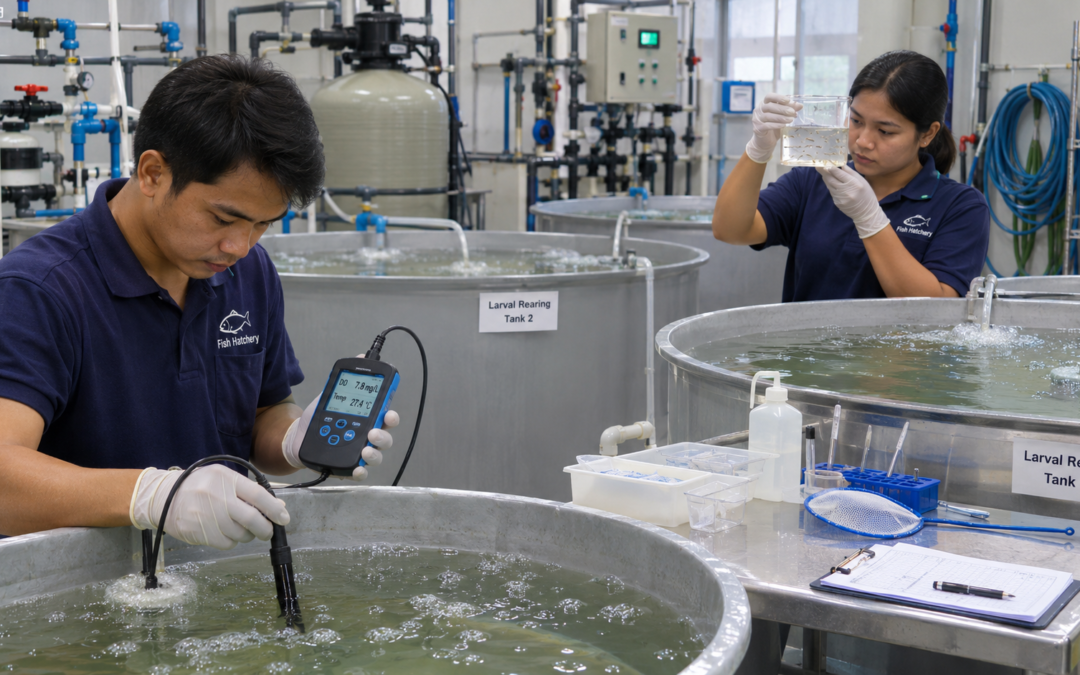
Water quality is especially important during the earliest stages of fish production. Eggs and newly hatched larvae have limited ability to cope with rapid changes in temperature, low dissolved oxygen, accumulating ammonia, or unstable pH. Small changes that an adult fish might tolerate can interfere with feeding, development, or survival in a hatchery tank.
The requirements are not identical for every species, so hatchery managers should work with species-specific targets rather than one universal set of numbers. An FAO guide for small-scale fish hatcheries, for example, lists suitable inlet-water conditions of pH 6.5 to 8.5, temperatures of 23°C to 32°C, and dissolved oxygen of at least 3 mg/L. Those figures illustrate the need for controlled water quality, but exact operating ranges should match the species and developmental stage being raised.
Temperature and Dissolved Oxygen Shape Early Development
Temperature affects metabolism, digestion, growth rate, oxygen demand, and the timing of developmental stages. Fish larvae generally perform best within a relatively narrow species-specific temperature range, so abrupt fluctuations can be more damaging than gradual changes. FAO hatchery guidance emphasizes that successful larval rearing requires suitable water temperature with as little fluctuation as possible.
Dissolved oxygen is equally important. Larvae need oxygen for normal metabolism and growth, but oxygen availability declines as water warms and as fish, microorganisms, and decomposing organic material consume it. FAO guidance for African catfish larvae recommends maintaining dissolved oxygen at or above 5 mg/L, while also warning that excessive water flow can physically press delicate larvae against screens or other surfaces.
Research demonstrates why oxygen deserves such close attention. A U.S. Geological Survey study of lake herring embryos found that normal fry production declined noticeably below 4 mg/L dissolved oxygen, and development was delayed under several low-oxygen treatments. The exact threshold varies by species, but the study illustrates how oxygen conditions can affect both survival and developmental quality before fish even reach the juvenile stage.
Ammonia and pH Must Be Managed Together
Fish continuously produce nitrogenous waste, and uneaten feed adds more nitrogen as it decomposes. In hatchery systems with high stocking densities and frequent feeding, ammonia can accumulate quickly when filtration, water exchange, or biological treatment is inadequate. The un-ionized form, NH₃, is the most toxic to fish and can damage gill tissue and disrupt normal physiology.
The proportion of ammonia present as toxic NH₃ increases as temperature and pH rise. FAO aquaculture guidance explains that the fraction of total ammonia in the toxic un-ionized form increases with increasing water temperature and pH. This means an ammonia concentration that appears manageable under one set of conditions may become more dangerous if the water becomes warmer or more alkaline.
Hatchery managers should therefore measure pH, temperature, and ammonia together rather than treating them as unrelated numbers. UF/IFAS recommends routine monitoring of ammonia, nitrite, pH, temperature, alkalinity, and dissolved oxygen in recirculating aquaculture systems. Feeding rates, fish load, biofilter capacity, solids removal, and water source all influence how quickly these parameters change.
A functioning biofilter is particularly important in recirculating systems because nitrifying bacteria convert ammonia into nitrite and then nitrate. Excess feed, dead larvae, fecal material, or inadequate biofilter capacity can overwhelm that process, making good housekeeping part of water-quality management rather than simply a cleanliness issue.
Clean Water and Gentle Flow Protect Delicate Larvae
Suspended particles and excess organic material can create problems even when temperature and oxygen appear acceptable. Fine solids may irritate delicate gills, while decomposing feed and waste increase biological oxygen demand and encourage unwanted microbial growth. FAO guidance for freshwater prawn hatcheries recommends minimizing suspended organic material to reduce bacterial proliferation, biological oxygen demand, and stress.
Water exchange and treatment therefore need to be managed carefully. Incoming water should be appropriate for the species and, where necessary, filtered or disinfected before entering larval tanks. The same FAO guidance notes that new water in recirculating hatcheries should be disinfected and filtered before introduction, rather than assuming every fresh water source is automatically safer than the water already in the system.
Flow rate also matters because larvae are physically fragile. Water must move enough to maintain oxygen and remove waste without creating currents that exhaust larvae or trap them against screens. FAO’s African catfish guidance reports a larval-rearing flow rate of about 3 to 5 liters per minute for the particular system described, while cautioning against excessive flow.
Regular siphoning of dead organisms, waste, and excess feed can help maintain water quality, but disturbance should be gentle. Tank-cleaning procedures need to account for larval size and behavior so that efforts to improve water quality do not physically injure the fish.
Feeding and Stocking Density Change Water-Quality Demand
Stocking density and feeding rate determine how quickly a hatchery system consumes oxygen and produces waste. More larvae in the same volume of water increase respiration, while additional feed raises both metabolic waste and the amount of uneaten organic material that must be processed. Hatchery capacity therefore depends on aeration, filtration, water flow, tank design, and management rather than tank volume alone.
A 2017 study of pinfish and pigfish eggs found that stocking densities above 250 eggs per liter reduced pinfish hatching success and degraded water quality, including lower dissolved oxygen and pH and higher nitrogenous wastes. The threshold should not be applied to unrelated species, but the experiment demonstrates how stocking density can directly change both water conditions and larval performance.
Monitoring should become more frequent as systems become more intensive. UF/IFAS recommends measuring ammonia, nitrite, pH, temperature, and alkalinity daily in developing recirculating systems and checking dissolved oxygen several times each day in heavily stocked or heavily fed systems. Observing larval swimming, feeding response, distribution in the tank, and abnormal mortality provides additional information that instruments alone may miss.
Good hatchery management depends on keeping several variables stable at the same time. Temperature influences metabolism, oxygen affects development, pH changes ammonia toxicity, and stocking and feeding determine how rapidly the entire system consumes oxygen and accumulates waste. Regular measurement, gentle water movement, appropriate filtration, careful feeding, and species-specific operating targets give fish larvae a more stable environment during their most vulnerable stages.
Join the EAT Community at https://www.eatcommunity.com/ to learn from experienced farmers and explore practical strategies for sustainable aquaculture and fish-farm management.